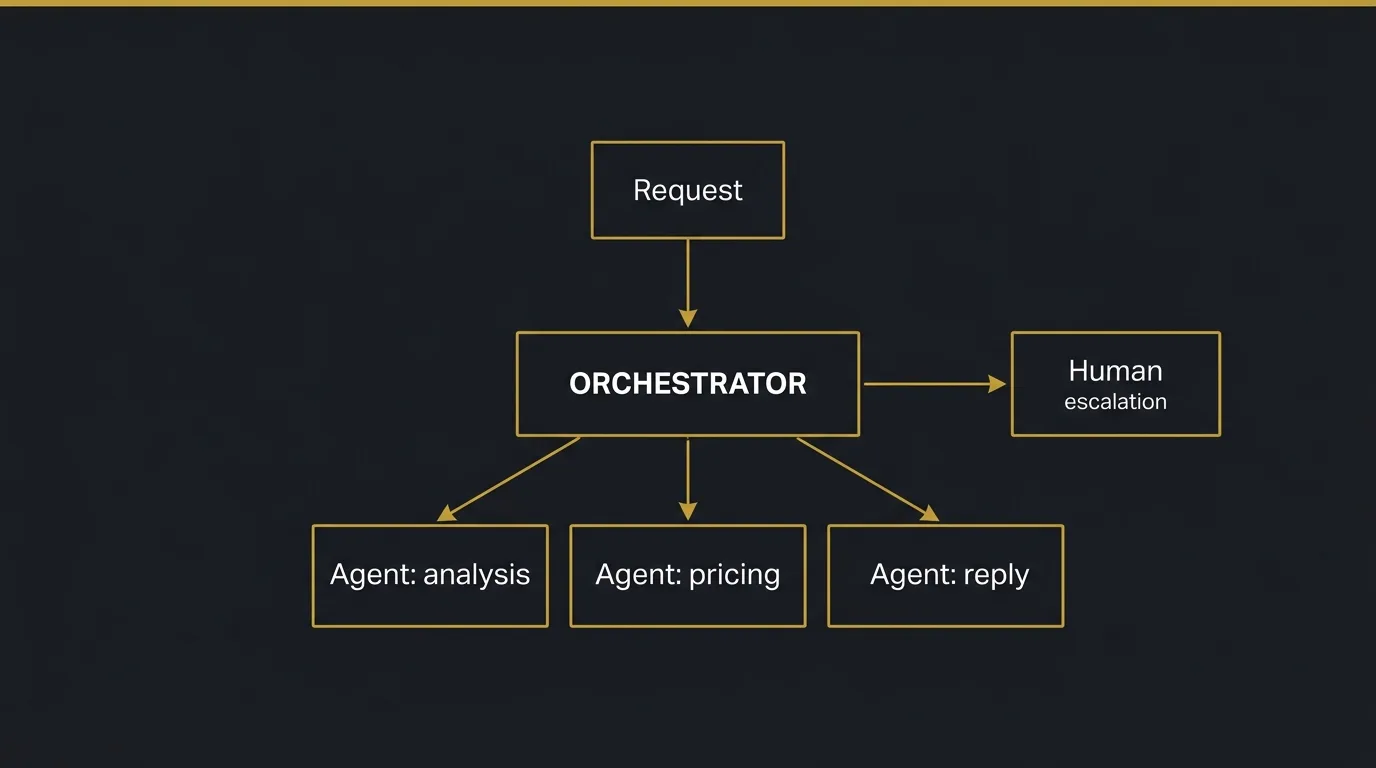
An orchestrator is the component that manages how many parts of a system work together: it sets the order of steps, passes data between them, handles failures, and decides when a task needs a human. It does no domain work itself — just as a conductor plays no instrument, yet without one the orchestra falls apart.
Where the word comes from
"Orchestration" entered computing long before AI agents. The best-known orchestrator in the world is Kubernetes — the system that manages hundreds of containers: deciding where each one runs, restarting the ones that crash, scaling the ones under load. Equivalent tools exist for data pipelines (Apache Airflow, for instance) and for business processes. The common denominator never changes: many independent parts, plus one layer that manages them.
So when people talk about an "AI agent orchestrator" today, it is not a new idea — it is a proven pattern applied to a new kind of component: instead of containers or ETL jobs, the managed units are agents built on language models.
What an orchestrator actually does
Whether it manages containers or AI agents, an orchestrator is responsible for four things:
- Ordering and dependencies — which component works when, and what has to finish before the next step starts.
- Data flow — the output of one step becomes the input of the next, with no manual copying.
- Failure handling — retrying a step, taking a fallback path, or escalating when something goes wrong.
- Visibility — one place that shows the state of the whole process, instead of digging through each component's logs separately.
Orchestrator vs. scheduler, automation and agent
| Concept | Responsible for | What it does not do |
|---|---|---|
| Scheduler | runs tasks at a set time or interval | knows nothing about dependencies between tasks or the content of their results |
| Automation (workflow) | executes a pre-written script: if condition A, do B | does not interpret content — it only evaluates logical conditions |
| AI agent | does the domain work that requires interpretation (reads, classifies, replies) | does not manage other agents or the process as a whole |
| Orchestrator | manages ordering, data, failures and escalation across the whole process | does no domain work — it delegates that to the components beneath it |
The orchestrator in AI agent systems
In a multi-agent system, the orchestrator solves a problem that appears in every company after the second or third agent goes live: each one works in isolation, none passes context to the next, and a human ends up as the manual glue between them. The orchestrator takes over that role — it assesses each request, routes it to the right agent, keeps the data flowing, and knows when a case should reach a human with full context attached.
We cover this layer in more depth — including the three common patterns (pipeline, router, supervisor) — in What is AI agent orchestration.
How to tell your company needs one
Three practical signals. First: more than one agent or AI tool works in a process, and a human carries the data between them. Second: nobody can answer "what stage is this request at" without checking several systems. Third: agent mistakes only surface when a customer complains — because there is no single place showing that a step returned a low-confidence result.
If none of these signals is present — say, the company runs one agent on one task — an orchestrator is unnecessary at that stage. We say so honestly in When a company is NOT ready for AI orchestration.
Frequently asked questions
What is an orchestrator, in plain terms? A component that manages the work of other parts of a system — ordering, data, failures, escalation — without doing any of the domain work itself.
How is it different from a scheduler? A scheduler only answers "when to run". An orchestrator also answers "in what order", "with which data" and "what happens when a step fails". Scheduling is often one function inside an orchestrator, never the reverse.
Is an AI agent orchestrator software or a service? Technically, a software layer (built, for example, on a framework such as LangGraph). In implementation practice, the word is also shorthand for the service of designing that layer around a company's specific process — which is what Orkiestrator AI does.
Curious how such a layer is built in practice? The process, from audit to handover, is described in Multi-agent system implementation step by step, and realistic cost ranges in The cost of implementing AI orchestration.