The most common mistake in AI implementations is not technical — it is a mistake of order. A company starts by choosing a tool ("let's buy licences", "let's launch a chatbot") and only then looks for something to do with it. The order that works is the reverse: process first, then data, then one pilot with measurable results — and the tool is chosen last, to fit a specific job.
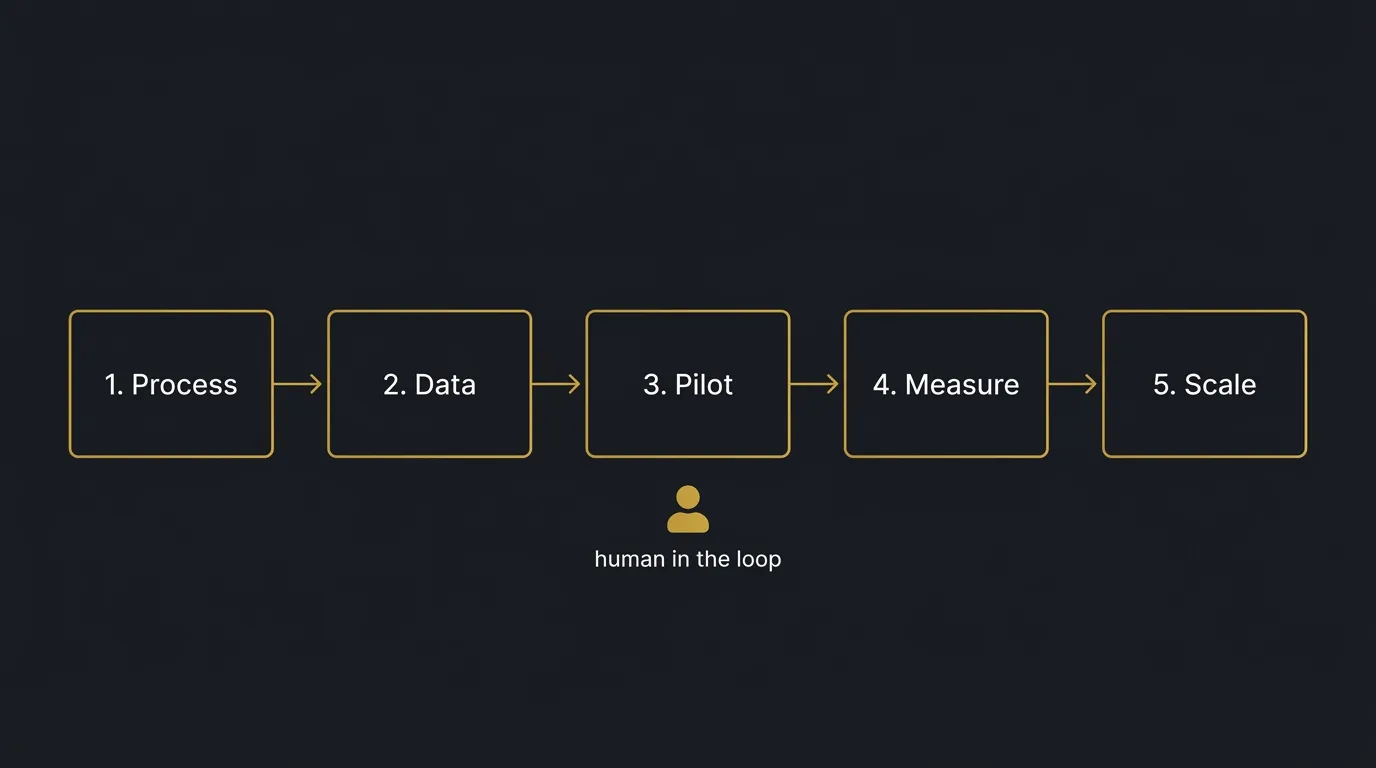
Step 1: pick one process, not an "AI strategy"
A good first candidate for automation meets three conditions at once: it is repeatable (it happens daily or weekly, following a similar pattern), it is describable (an experienced employee can explain how they do it and how they know the result is good), and it has a low cost of error (a mistake is easy to catch and undo before it reaches a customer).
Processes that typically qualify: initial triage of sales inquiries, document classification and tagging, drafting replies to repetitive emails, extracting data from invoices or orders. Processes that typically do not qualify at the start: pricing decisions, communication in customer disputes, anything touching sensitive data without established access rules.
Step 2: check the data of that one process
You do not need to "clean up data across the company" — that myth blocks implementations for years. You do need an honest look at the inputs and outputs of the chosen process: where do requests come from (email? a form? phone calls typed up by hand?), where is the result recorded, and do at least a few dozen historical examples of "the job done well" exist, against which the agent's output can be verified.
If half the inputs are unstructured — say, phone arrangements never written down — the first implementation step is not AI but unifying the input; otherwise the agent will automate only half of reality.
Step 3: pilot a single agent with a human in the loop
The first agent should run in assistant mode: it prepares the result, a human approves it. This is not "incomplete automation" — it is the stage where the company collects two things for free: quality data (how often we correct the agent, and on what) and team trust (people see what the agent does before handing the process over). Only when the correction rate drops to an acceptable level should some cases flow through without approval.
Step 4: measure from day one
The measurement minimum is three numbers: time (how long a case took before and after), quality (the share of results needing correction) and coverage (what percentage of cases the agent handles alone versus escalates). Without these numbers, any conversation about expanding the rollout comes down to impressions — and impressions are always enthusiastic for the first month of anything new.
Step 5: scale — and this is where orchestration comes in
Once the first agent works and has numbers behind it, the natural next move is a second process and a second agent. That is the moment — not earlier — when you need a layer that manages how agents cooperate: passing context between them, keeping order, escalating to a human. What exactly that layer is, we cover in What is an orchestrator? and What is AI agent orchestration.
What not to do at the start
- Don't begin by buying an "everything platform" — after picking the process, a much simpler (and cheaper) tool may turn out to be enough.
- Don't automate a process nobody can describe — the agent will not guess rules that nobody in the company knows.
- Don't skip the human-in-the-loop stage — it is the only period when the agent's mistakes are cheap.
- Don't measure "satisfaction with AI" instead of time, quality and coverage.
Frequently asked questions
Where should a small company start? With one repeatable, describable process with a low cost of error — not with a tool. The tool is chosen last, to fit the job.
Do we need clean data across the whole company? No — consistent data for the one chosen process plus a few dozen historical examples of the work done well are enough to verify the agent.
When does orchestration appear? When more than one agent is live and they start handing work to each other. Before that it is unnecessary cost — we say so plainly in When a company is NOT ready for AI orchestration.
To see the full process — from audit to handover — read Multi-agent system implementation step by step; realistic cost ranges are in The cost of implementing AI orchestration.